Figure 1 — Model Overview
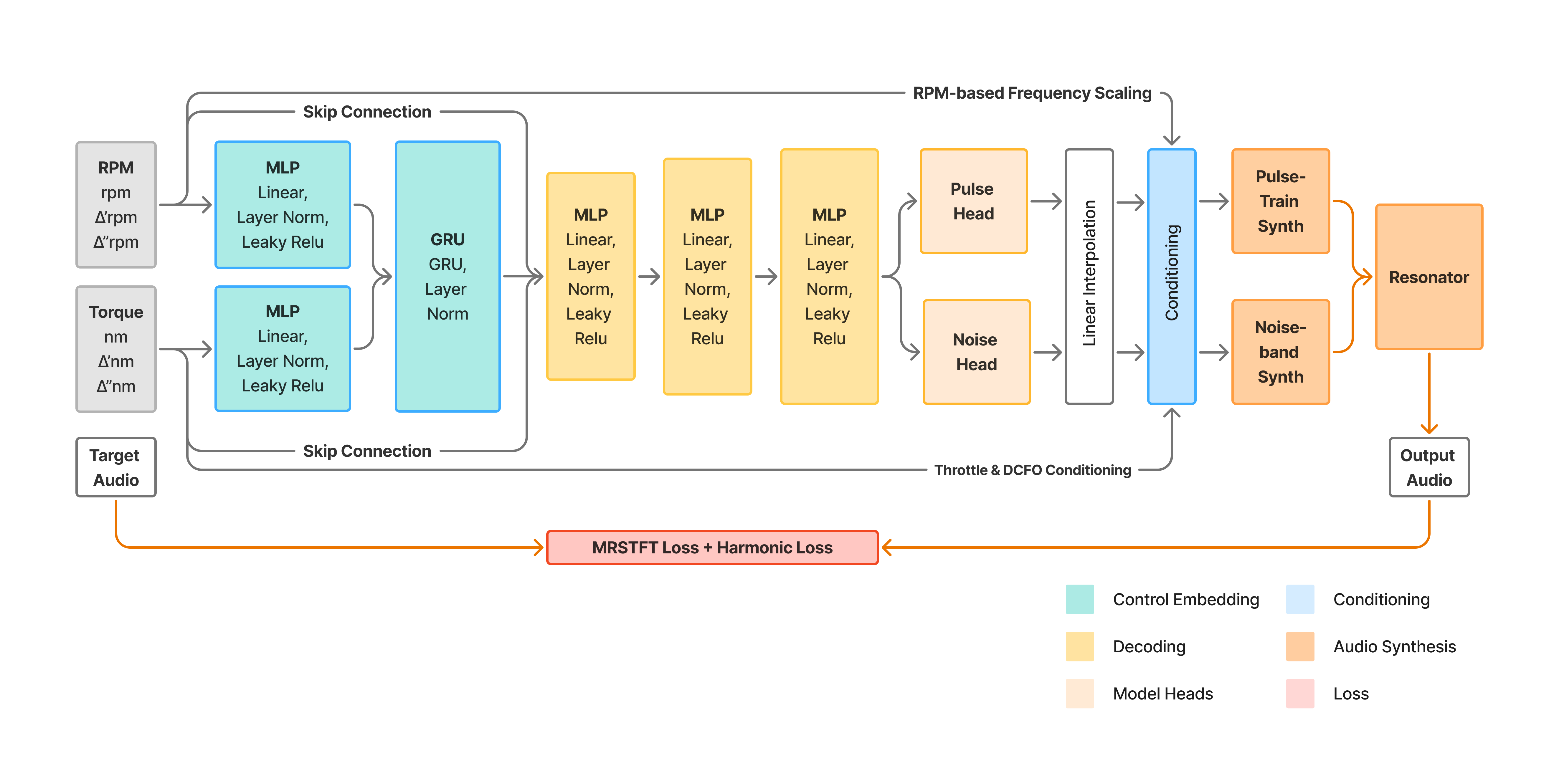
Control features (RPM, torque) and their deltas are temporally embedded via MLP blocks and GRU. Outputs are decoded into synth parameters through MLP blocks, converted to parameter ranges by specialized heads (Pulse, Noise), upsampled to audio rate and scaled by conditioning signals. Audio is synthesized via differentiable modules with parameter updates calculated from multi-resolution spectral and harmonic losses.
Audio Examples
Three conditions are compared:
Target — ground-truth engine recordings;
HPN — harmonic-plus-noise baseline (same encoder–decoder structure but standard harmonic plus noise synthesis); and
PTR (ours) — the proposed Pulse-Train-Resonator model.
Spectrograms are shown as visual reference. Click ▶ to play, or click the waveform to seek.
Citation
@inproceedings{doerflerPhysicsInformedNeuralEngine2026,
  title     = {Physics-{{Informed Neural Engine Sound Modeling}} with {{Differentiable Pulse-Train Synthesis}}},
  author    = {Doerfler, Robin and Wyse, Lonce},
  booktitle = {Proc. 34th Eur. Signal Process. Conf. (EUSIPCO)},
  address   = {Bruges, Belgium},
  publisher = {EURASIP},
  month     = sep,
  year      = {2026},
  pages     = {76--80},
  isbn      = {978-94-645936-3-1},
  url       = {https://eurasip.org/Proceedings/Eusipco/Eusipco2026/pdfs/0000076.pdf}
}