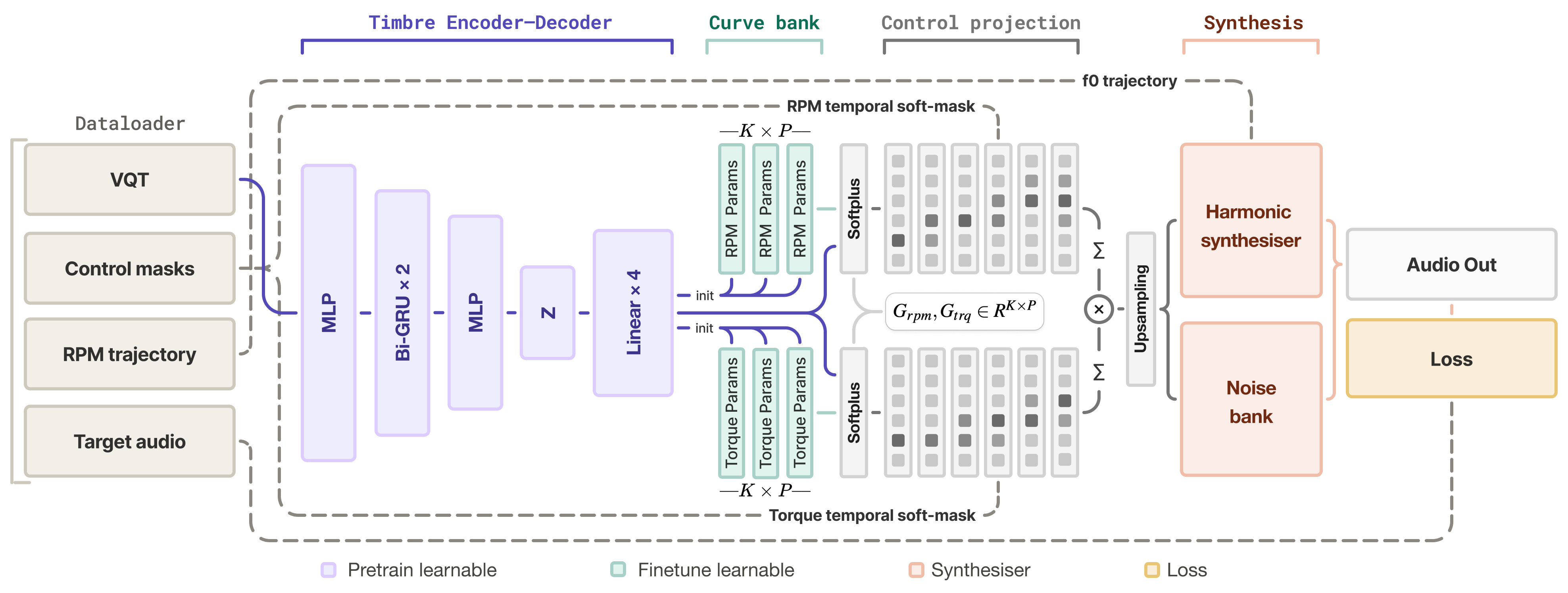
Input audio is provided as VQT spectrograms and encoded to a compact latent timbre representation, before being decoded into RPM and torque gain curves that form the shared parametrization for end-to-end training and direct DSP export at inference. Gain curves are projected onto temporal soft-masks to yield time-varying amplitude envelopes, which drive a differentiable harmonic synthesizer (f₀ derived from the RPM trajectory) and an ERB noise bank. Training minimizes a combined multi-resolution STFT and harmonic loss against the target audio.
Demo Videos
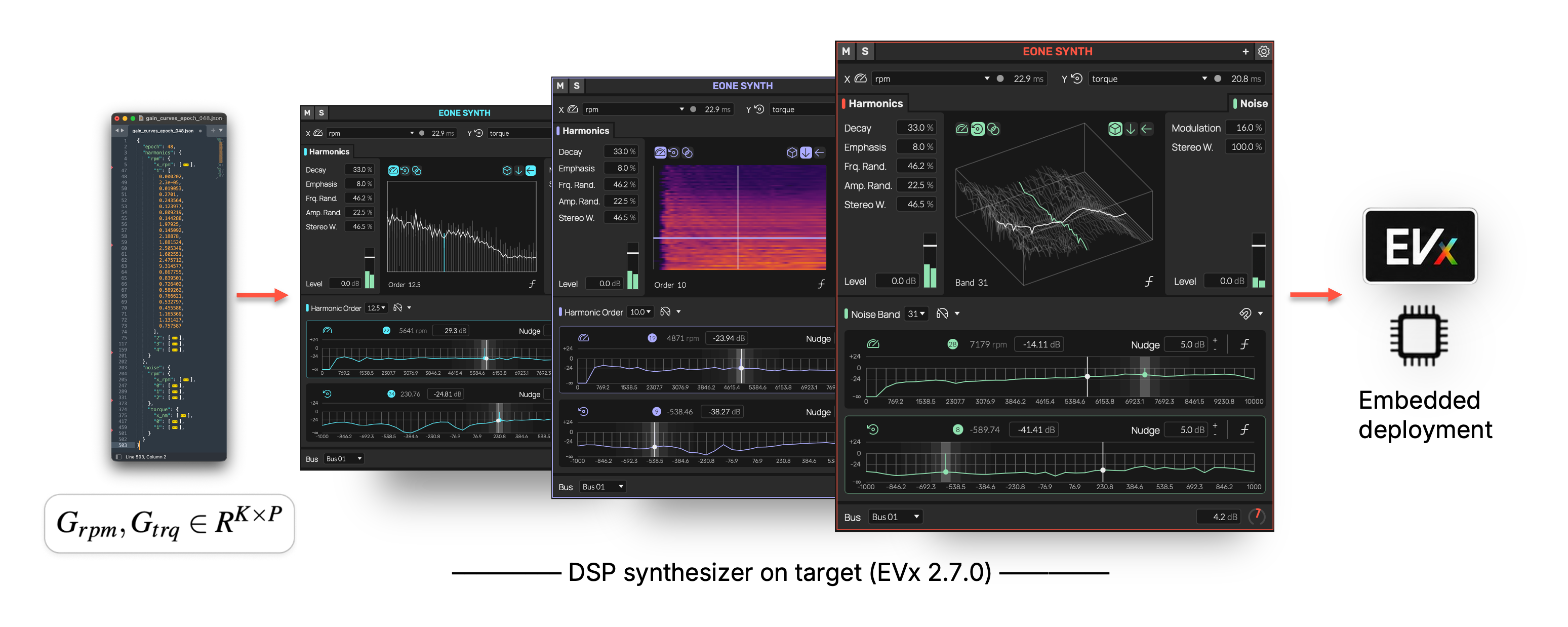
User interface of the embedded synthesizer implementation in EVx 2.7.0. The gain curves (left) are exported from the trained model as raw JSON and read directly by the EONE Synth, enabling efficient resynthesis and parameter tuning on the target device.
Visualization of the gain curves exported from the model as an amplitude-landscape cube. The translucent lines forming the landscape are the per-harmonic and per-noise-band amplitude factors (Grpm, Gtrq) or their resulting amplitude product (A); the white trace marks the current read-out position driven by the control parameters (RPM, torque). The landscape can be inspected in three modes: (1) as a cube, with harmonics on the Z axis, RPM / torque (or their product) on the X axis, and amplitude on the Y axis; (2) as a 2D view, with harmonics on the X axis and amplitude on the Y axis; and (3) as a heatmap, with harmonics on the Y axis, RPM, torque or their product on the X axis, and amplitude encoded as color. The curves along the bottom show the gain factor over RPM (top) and torque (bottom) for the selected harmonic or noise band. The video steps through these visualization options in turn.
Illustration of the representation’s transformability through parametric adjustment and through the contribution of individual components: noise versus harmonics, higher versus lower harmonics, and odd versus even harmonics. The number boxes expose additional transformation options that are not learned by the model, such as harmonic decay and emphasis, frequency and amplitude randomization, and stereo width. These can be applied creatively during sound design.
Demonstration of the EONE synthesizer in a more comprehensive context, running within a video game in which the control parameters (RPM, torque) drive the synthesis in real time. Additional sound effects, such as pops and burble, are layered in via sample playback.
Audio Examples: Listening-Test Stimuli
Citation
@inproceedings{doerflerGradientBasedLearningParametric2026,
  title     = {Gradient-Based Learning of Parametric Engine Sound Representations for Real-Time Resynthesis and Tuning on Embedded Systems},
  author    = {Doerfler, Robin and Kuntz, Matthieu and Zimmer, Clemens},
  booktitle = {Proc. 2026 AES 6th International Automotive Audio Conference},
  address   = {Detroit, MI, USA},
  publisher = {Audio Engineering Society},
  month     = jul,
  year      = {2026},
  note      = {Paper 27},
  url       = {https://aes.org/publications/elibrary-page/?id=23420}
}